The session
On 9 November 2026 Jungsoo Kim gave about two hours of consulting to the Sound State Intelligence Lab (사운드상태지능랩) at Seoul National University of Science and Technology, as part of the 2026 TeX-Corps Global Market Entry Strategy program (TeX-Corps 「글로벌 진출전략 수립」). The lab is led by Jeong Seung-gyu, CEO of MediSensing (㈜메디센싱). The subject was the global strategy for Dadok (다독), the parenting AI agent the lab and the company are building. The session followed an agenda prepared from a review of the team’s materials and covered everything on it.
Dadok
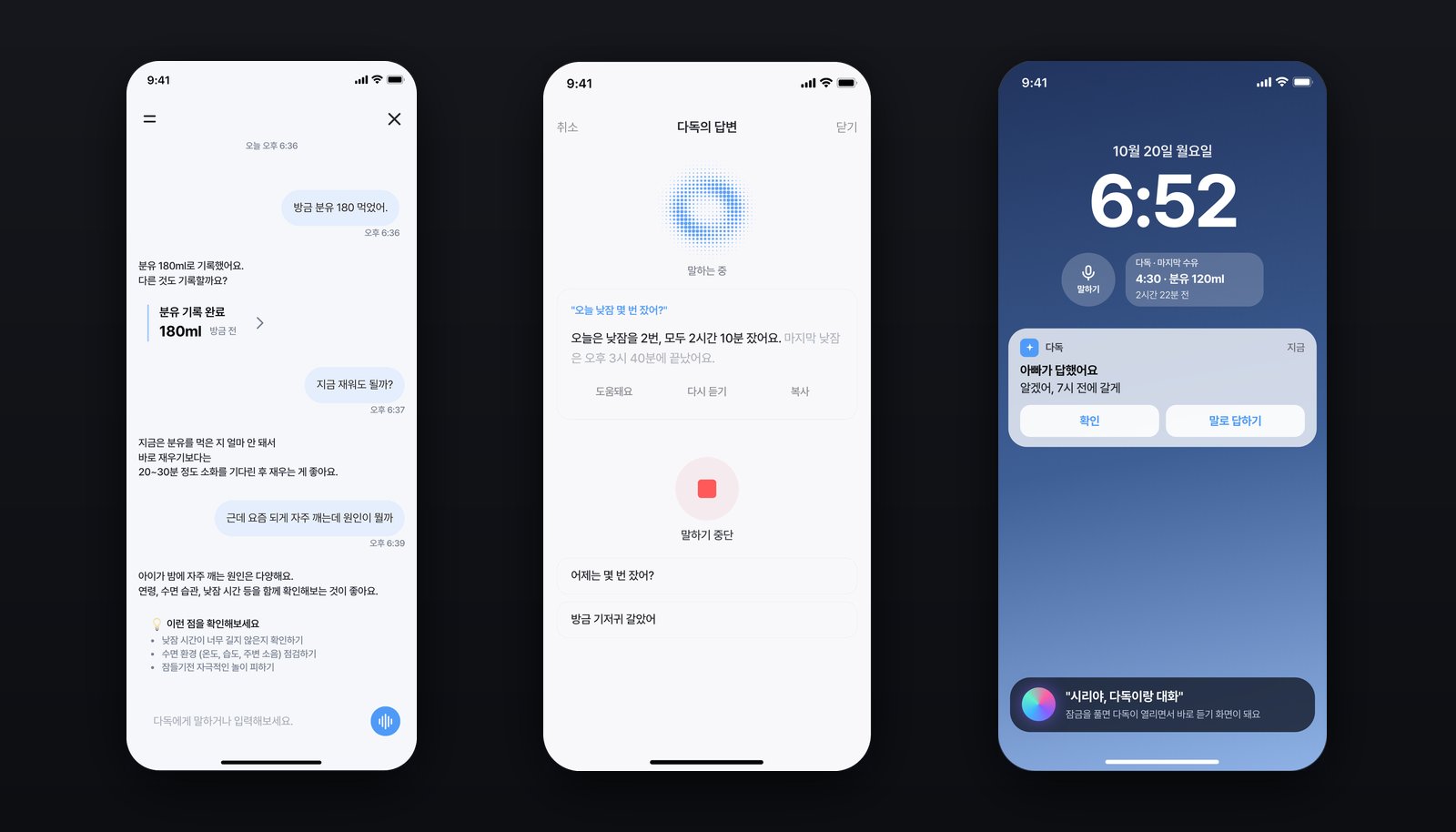
Dadok is a “parenting AI agent you record with and ask by voice,” released by MediSensing on the App Store for iPhone in August 2026. A parent holding a baby can say “just had 180 of formula” and the feeding, sleep, or diaper entry is logged. A misheard entry is corrected by voice: “no, 150.” Ask “when was the last feeding?” and it looks up that child’s records and answers. Mother, father, and grandparents see the same log and continue it. The 1.3 update in November added free-form voice conversation and logging straight from Siri and widgets.
The Sound State Intelligence Lab is a research lab at the university working on sound analysis. According to the product brochure, Dadok is preparing a feature in which a device placed beside the baby listens to the baby’s sounds overnight and logs them.
What the session covered
The session ran in five parts.
The first was a review of where things stand. Kim shared what he had taken from the brochure and planning documents and checked where it differed from the facts. The twenty features on the roadmap were grouped into four strands, reducing the effort of logging, proactive guidance from the records, the hours when parents cannot log, and memories and sharing, each with a one-line statement from the user’s side. He also asked why the launch began with the first strand when the lab’s core technology, sound analysis, belongs to the third. On the reliability of the records he proposed a principle: even when logging becomes automatic, the morning report should distinguish what was detected, what was inferred, and where there is no record.
The second was the product description and reviews. Instead of a list of features, he suggested describing the product in one sentence built on a situation a parent recognizes at once, such as “a baby log you keep by voice while holding the baby.” The phrase “parenting AI agent” is accurate as a statement of the company’s direction but conveys nothing to a parent hearing it for the first time. Using a Japanese user review from 2012, he explained that reviews arise from particular experiences, such as the moment a question gets an answer, while the convenience that sustains daily use is a separate matter.
The third was the revenue model and a dedicated device. User response builds in the order of recognizing usefulness, returning, and paying, so the paid tier should be set in that order. A dedicated device has a reason to exist only when it clearly removes the inconveniences of leaving a phone by the pillow; if it too has to be charged every day, it is no different from a phone. For institutional channels such as postpartum care centers, he noted, the satisfaction of the mothers and the reduction of staff workload are different problems.
The fourth was entering Japan. The five items in the team’s market survey, segment and channel, competition and positioning, localization and pilot, regulation and privacy, and partners, were taken in turn. Since the paid-app market of 2012 and the parenting-app market of 2026 are different markets, he proposed treating the earlier Japan experience not as evidence of success but only as a guide to the first interview questions. On regulation, the first line of defense is to keep the scope, “records and comparisons only, with no judgments, warnings, or real-time alerts,” consistent from the store description to customer support replies.
The fifth was questions and a summary. The reference case, While You Were Sleeping (「당신이 잠든 사이」), is an iPhone app Kim developed and ran himself from 2010 to 2016, which held first place in the Health category of the Japanese App Store from 2012 to 2014. The summary came down to the three recommendations below.
Three recommendations
First, describe the product through one concrete situation. Instead of a list of features, pick a single moment a parent recognizes at once. The same rule applies when the text is translated into Japanese.
Second, separate the experience that produces a review from the value that sustains use. Reviews come early and subscriptions come later. Design and measure them separately.
Third, judge the dedicated device, overnight logging, and the move into Japan against those two values. For Japan, begin with user interviews, as planned.
The session ended on one question. If a parent who uses Dadok described it to another parent in a sentence, what would the team want that sentence to be?
Closing
The TeX-Corps Global Market Entry Strategy program pairs university start-up exploration teams with outside advisers to work out a strategy for entering overseas markets. The Dadok app can be found by searching for “다독” on the App Store.