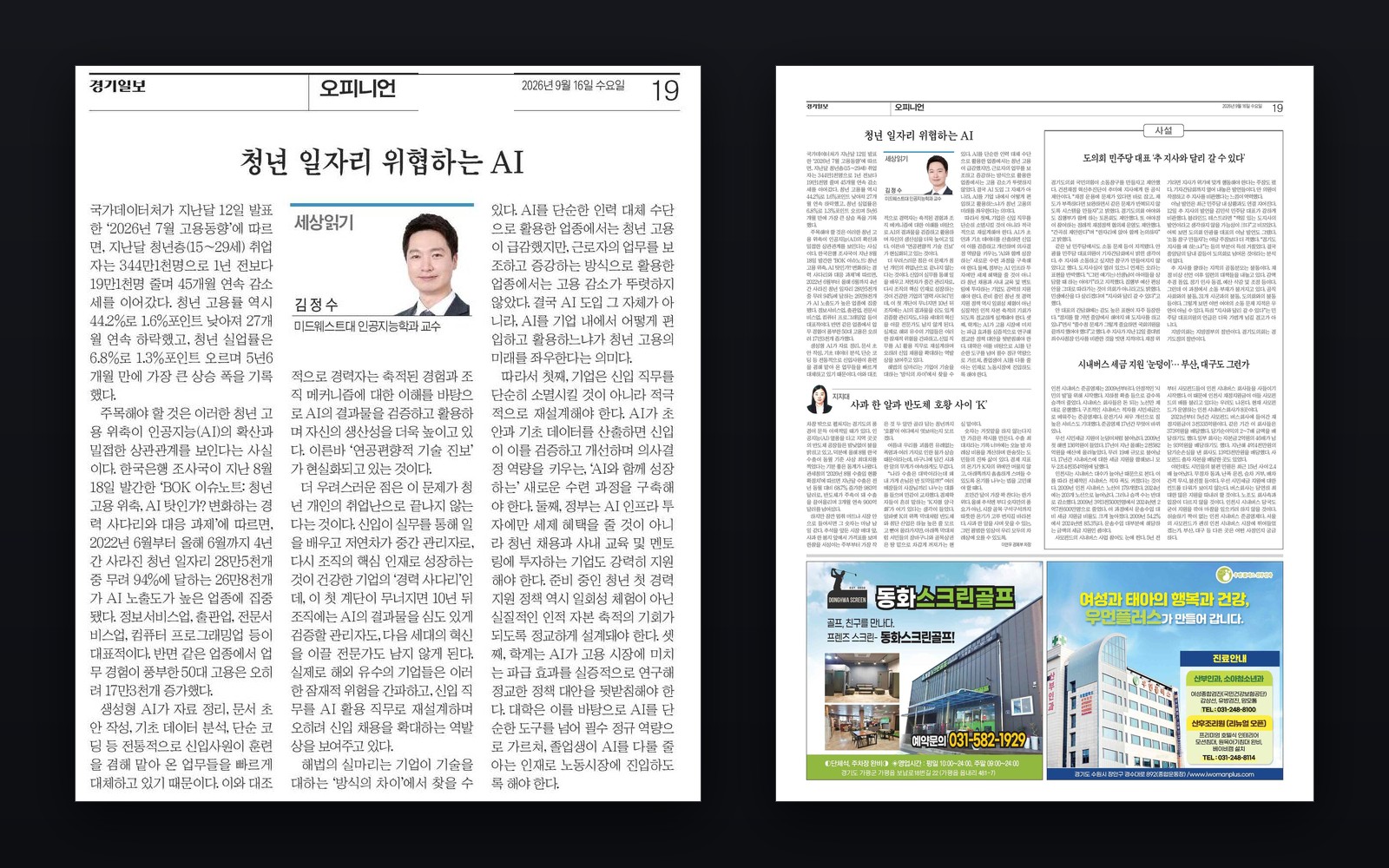
The column
On 15 September 2026 Kyeonggi Ilbo published a column by Jungsoo Kim in its opinion section Reading the World (세상읽기), under the headline “AI Threatens Youth Jobs, and Should Be a Tool for Augmentation, Not Replacement” (청년 일자리 위협하는 AI, '대체' 아닌 '증강'의 도구로 삼아야). The byline reads Professor of Artificial Intelligence, Midwest University. The online edition appeared on 15 September, and the print edition ran on Wednesday 16 September on page 19, the opinion page, under the shorter headline “AI Threatens Youth Jobs” (청년 일자리 위협하는 AI). The full text of the column follows below.
The column starts from the national employment figures for July 2026 published by the Korea National Data Agency (국가데이터처). Youth employment had fallen for forty-five months in a row, and the youth unemployment rate had risen by the most in five and a half years. A Bank of Korea research note found that ninety-four percent of the youth jobs lost over four years were in industries with high exposure to AI, while employment of workers in their fifties in those same industries had grown. The column locates the cause not in the adoption of AI itself but in how firms use it. Where AI replaced the work that used to go to new hires, youth employment fell sharply. Where it was used to assist and augment workers, the fall was not pronounced. From this it asks firms to redesign entry-level jobs, the government to support youth hiring and in-house training, and universities to study the effects empirically and to teach AI as a core competence.
The original Korean text is on the Kyeonggi Ilbo article page.

Full text of the column
Translated from the Korean original.
According to the July 2026 Employment Trends (2026년 7월 고용동향) released by the Korea National Data Agency on the 12th of last month, the number of employed young people aged 15 to 29 stood at 3,441,000 last month, down 191,000 from a year earlier and the forty-fifth consecutive month of decline. The youth employment rate also fell 1.6 percentage points to 44.2 percent, its twenty-seventh consecutive monthly drop, and the youth unemployment rate rose 1.3 percentage points to 6.8 percent, the largest increase in five years and six months. Given that total employment grew by 108,000 over the same period, it is plain that the cold front in hiring is concentrated on the young.
This is not the aftermath of an ordinary downturn. It is a vast structural change in the labor market itself. The heart of the problem is not simply that the total number of jobs has shrunk. It is that the entry-level job postings through which young people take their first step into the labor market are disappearing. As firms favor experienced hires who can do the work on day one, postings for new graduates are vanishing.
What deserves attention is that this contraction in youth employment is closely correlated with the spread of artificial intelligence. According to the BOK Issue Note published by the Bank of Korea’s Research Department on 18 August, “Is AI to Blame for the Contraction in Youth Employment? The Changing Career Ladder and the Tasks Ahead” (BOK 이슈노트: 청년고용 위축, AI 탓인가? 변화하는 경력 사다리와 대응 과제), of the 285,000 youth jobs lost in the four years from June 2022 to June of this year, fully 94 percent, or 268,000, were concentrated in industries with high exposure to AI. Information services, publishing, professional services, and computer programming are representative. In those same industries, by contrast, employment of workers in their fifties with deep experience actually grew by 173,000. As a result, the share of young people among all new hires fell sharply, from a pre-pandemic average of 36.9 percent to 29.3 percent recently.
Why is this happening? Because generative AI is rapidly taking over the tasks that new employees traditionally handled as part of their training: organizing material, drafting documents, basic data analysis, simple coding. Experienced workers, by contrast, draw on accumulated experience and an understanding of how the organization works to verify and use what AI produces, and so raise their own productivity further. What is becoming real is a so-called seniority-biased technological change, in which technical progress replaces the labor of beginners and augments the capability of the skilled. In particular, the fact that the unemployment rate of young university graduates has risen above that of young people with junior college degrees or less since the release of ChatGPT shows that AI is digging into cognitive and analytical work first. Add to this the rigid labor market practice of keeping existing staff while cutting new hiring first, and the shock is passed straight on to those just starting out.
More worrying is that this problem does not end with the job search of individual young people. In a healthy company, the career ladder runs from new hires learning the work by doing it, to junior staff becoming middle managers, to those managers becoming the core talent of the organization. If the first rung collapses, then ten years from now the organization will have neither managers able to scrutinize what AI produces nor experts to lead the next generation of innovation. Cutting entry-level hiring today may help with short-term cost savings, but in the long run it can only come back as a heavy bill: the depletion of human capital and the erosion of corporate value. Leading companies abroad have in fact seen this latent risk, and are showing the opposite instinct, redesigning entry-level roles around the use of AI and expanding new hiring.
The thread of a solution can be found in the difference in how firms approach the technology. In industries that used AI simply as a means of replacing people, youth employment fell steeply, but in industries that used it to assist and augment the work of employees, the decline in employment was not pronounced. In the end it is not the adoption of AI as such but how a firm incorporates and uses AI that will decide the future of youth employment.
Therefore, first, firms should not simply let entry-level jobs disappear but actively redesign them. They should build a new form of apprenticeship, one of growing together with AI, in which AI produces drafts and basic data and new hires verify and improve them, building their capacity for judgment. Second, the government should not give tax incentives only for investment in AI infrastructure, but should strongly support firms that invest in hiring young people and in in-house education and mentoring. The youth first-career support policy now in preparation should likewise be designed with care so that it becomes a real opportunity to accumulate human capital rather than a one-off experience. Third, academia should study the effects of AI on the labor market empirically and underpin precise policy alternatives. On that basis, universities should teach AI not as a mere tool but as a required core competence, so that graduates enter the labor market as people who know how to work with AI.
AI is a tide of the times that cannot be turned back. But whether we let this enormous technology knock out the first rung of the career ladder, or use it as a lever to set a sturdier new rung in its place, rests entirely on our choice. If we do not hire newcomers today, ten years from now we will have no experts either. It is time for firms, the government, and academia to pool their wisdom to reopen the door to a first job for the young.
The original column, in Korean, is on the Kyeonggi Ilbo opinion page for 15 September 2026: Reading the World. The printed page of 16 September, page 19, is attached as a PDF: 경기일보-2026-09-16-19면.pdf