The column
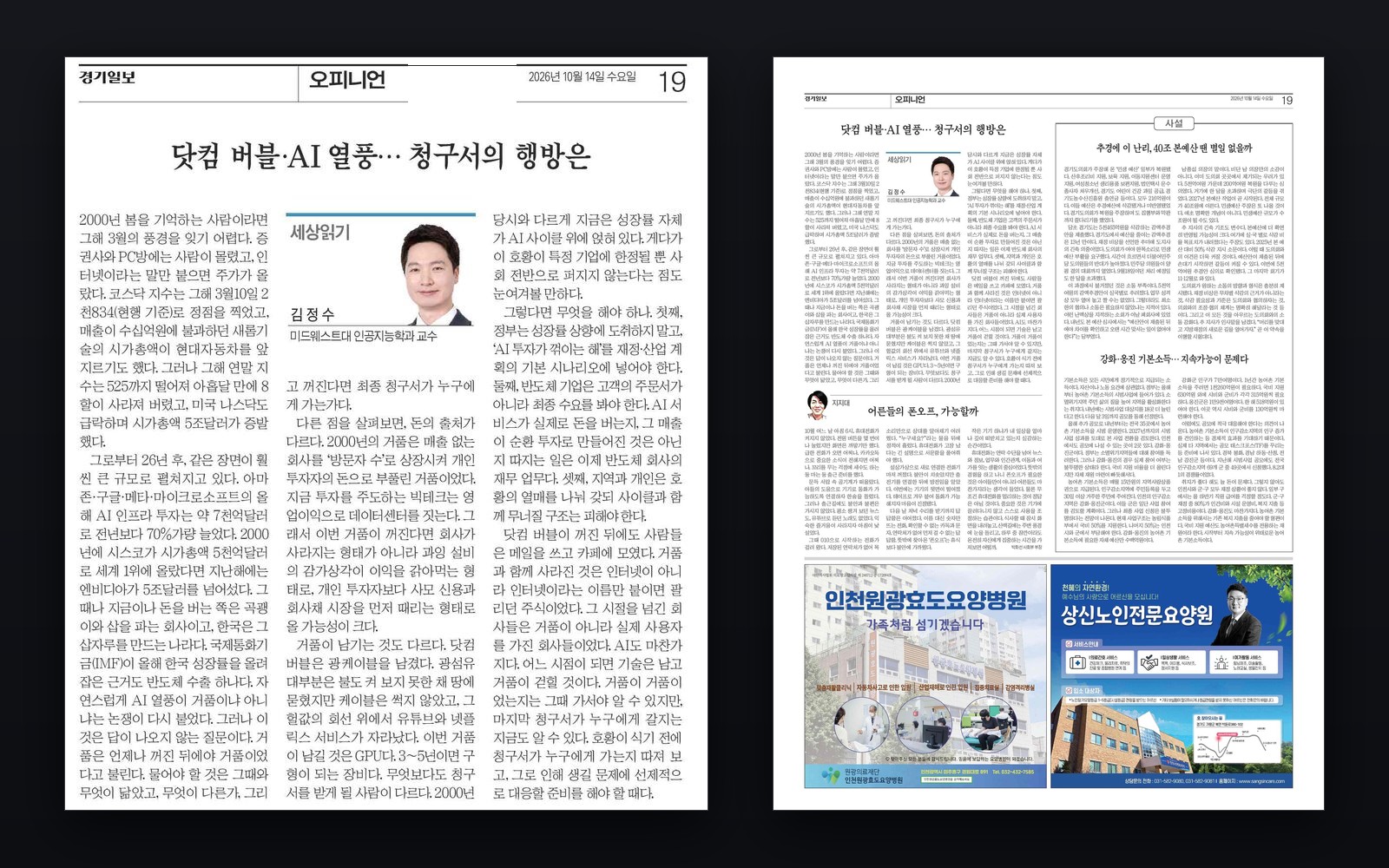
On 13 October 2026 Kyeonggi Ilbo published a column by Jungsoo Kim in its opinion section Reading the World (세상읽기), under the headline “The AI Boom and the Dot-Com Bubble: Ask Where the Bill Goes, Not Whether It Is a Bubble” (AI 열풍과 닷컴 버블, 거품 논쟁보다 ‘청구서’의 행방을 물어야). The byline reads Professor of Artificial Intelligence, Midwest University. The online edition appeared on 13 October, and the print edition ran on Wednesday 14 October on page 19, the opinion page, under the shorter headline “Dot-Com Bubble, AI Boom… Where Does the Bill Go?” (닷컴 버블·AI 열풍… 청구서의 행방은). The full text of the column follows below.
The column starts from the KOSDAQ and the Nasdaq in March 2000. Twenty-six years later, with four big tech firms spending about 700 billion dollars on AI infrastructure and Nvidia’s market value past five trillion, it takes the question of whether this is a bubble to be one with no answer, since a bubble is only called one after it bursts. It asks instead what resembles that time, circular investment that echoes vendor financing; what differs, data centers built from operating profit and GPUs that, unlike fiber-optic cable, go obsolete in a few years; and who will receive the bill. For Korea, whose growth now rests on the AI cycle, it proposes that the government, the semiconductor companies, and regions and individuals each have something to prepare.
The original Korean text is on the Kyeonggi Ilbo article page.
Full text of the column
Translated from the Korean original.
Anyone who remembers the spring of 2000 will find it hard to forget the scene that March. Brokerage offices and PC rooms were crowded, and a stock rose on the mere word “internet.” The KOSDAQ index peaked at 2,834 (on the current basis) on 10 March that year, and the market capitalization of Saerom Technology, a company with sales of only a few billion won, briefly overtook that of Hyundai Motor. By the end of the year, though, the index had fallen to 525, eight tenths of it gone in nine months, and the Nasdaq in the United States plunged 78 percent from 5,048 to 1,114 in October 2002, erasing five trillion dollars of market value.
Twenty-six years on, the same scene is playing out on a far larger scale. This year’s AI infrastructure investment by Amazon, Google, Meta, and Microsoft comes to about 700 billion dollars, up roughly 70 percent on the year before. In 2000 Cisco became the world’s most valuable company at 500 billion dollars; last year Nvidia passed five trillion. Then as now, the ones making money are the companies selling picks and shovels, and Korea is the country that makes the shovel handles. The reason the International Monetary Fund raised its forecast for Korea’s growth this year by a full 0.7 percentage points to 2.6 percent comes down, in the end, to one thing: semiconductor exports. Naturally the argument over whether the AI boom is a bubble has flared up again. But that is a question with no answer. A bubble is only ever called a bubble after it has burst. What we should ask is what resembles that time and what differs from it, and, if it does burst, to whom the final bill goes.
Take the resemblances to the dot-com bubble first. In 2000 the telecom equipment makers Lucent and Nortel sold their gear by lending money to the start-up carriers who would buy it, so-called vendor financing. Revenue showed up in the books, but the money had come out of their own pockets to begin with. When the carriers collapsed one after another, Lucent’s share price fell below a dollar. When the news came last autumn that Nvidia would invest up to 100 billion dollars in OpenAI and that OpenAI would use the money to buy Nvidia chips, it felt like déjà vu of a scene from twenty-five years earlier. It is a circular structure in which investment becomes revenue and that revenue becomes the grounds for further investment. In such a structure, the revenue figure is not evidence of final demand. This is a passage that Korea, an exporter of semiconductors, should read with particular care.
Now the differences. The source of the money is different. The bubble of 2000 was inflated with the money of retail investors, by taking companies with no revenue public on the strength of “visitor numbers.” Many of the internet companies listed at the time had barely any advertising revenue. The big tech firms leading today’s investment build their data centers out of operating profit. So if this bubble bursts, it is likely to come not in the form of companies disappearing but in the form of depreciation on surplus equipment eating into profits, and in a form that hits private credit and the corporate bond market before it hits retail investors. The Bank for International Settlements recently published a report comparing the sustainability of the financing of American AI investment with historical cases, out of the same concern.
What the bubble leaves behind is also different. The dot-com bubble left fiber-optic cable. Most of the fiber that was laid was buried without ever being lit, but cable does not rot, and on those dirt-cheap lines services like YouTube and Netflix grew up. The wreckage of the bubble became the seed capital of the next generation. What this bubble will leave is GPUs, equipment that becomes obsolete in three to five years. The power plants and the buildings will remain, but hundreds of billions of dollars of chips will not, which is why this looks like a bubble whose aftermath will be far harder to clean up.
Above all, the person who receives the bill is different. Unlike in 2000, growth itself now rests on the AI cycle. The Korea Institute for International Economic Policy (KIEP) has warned that if the AI cycle slows, today’s buffer could weaken too. It is also worth noting that this boom is confined to particular companies and is not spreading through society as a whole. The Korea Development Institute (KDI) found that although semiconductor exports and AI infrastructure investment lifted the economy, real wage growth in the first half of the year was only 0.3 percent, and consumption actually fell. If exports turn before the warmth spreads, all that remains is a cold domestic market. This is especially true of Gyeonggi Province’s semiconductor belt in Yongin, Pyeongtaek, Icheon, and Hwaseong, of Dongtan and Giheung, where house prices rose on the chip boom and were put under regulation, and even of local tax revenue, all of which hang on the cycles of a handful of companies.
So what should be done? First, the government should not be intoxicated by the upward revision to growth, and should put “the year AI investment turns down” into the baseline scenario of its fiscal and industrial plans. Surplus tax revenue in the boom years is money to be set aside as a cushion for the next cycle. Second, semiconductor companies should look at final demand, not at their customers’ order sheets. In 2000 the equipment makers expanded capacity on nothing but the carriers’ orders, and collapsed along with those orders. Checking whether AI services actually make money, and whether that revenue has been manufactured by circular investment, is now part of a chip company’s financial work. Third, regions and individuals should share in the fruits of the boom but avoid structures that will collapse along with the cycle. Staking house prices and local public finances wholesale on one industry’s investment plans is no different from putting an entire retirement payout into KOSDAQ stocks in 2000.
After the dot-com bubble burst, people still wrote email and gathered in online cafés. What vanished with the bubble was not the internet but the stocks that sold on nothing more than the word internet in their names. The companies that came through that era were the ones with real users, not bubbles. AI is the same. At some point the technology will remain and the froth will clear. Whether the bubble was a bubble can only be known then, but who will receive the last bill can be known now. In the dot-com bubble, individuals received that bill; this time the national economy may receive it. Before the boom cools, it is time to work out to whom the bill goes, and to prepare in advance for the problems that will follow.
The original column, in Korean, is on the Kyeonggi Ilbo opinion page for 13 October 2026: Reading the World. The printed page of 14 October, page 19, is attached as a PDF: 경기일보-2026-10-14-19면.pdf